> For the complete documentation index, see [llms.txt](https://docs.energyweb.org/llms.txt). Markdown versions of documentation pages are available by appending `.md` to page URLs; this page is available as [Markdown](https://docs.energyweb.org/launchpad/generic-and-energy-services/green-proofs-as-a-service/registry-functionalities-and-processes/processes.md). Agents can also search and read this documentation through its [MCP server](https://docs.energyweb.org/~gitbook/mcp).
# Processes
1. **Issue Unit**
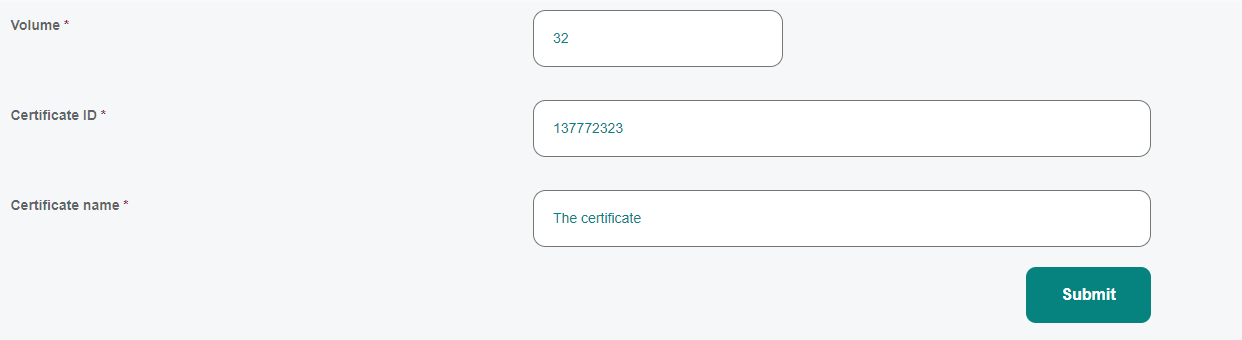
The first functionality for the end-user, after the company, account, users have been onboarded, is to create units. You can do this by going to the "Holdings Page" and pay attention to the top right corner with the "Issue Unit" Functionality 
You can define the certificate in the most basic form at this stage, with more configuration available in the near future
Click Submit to generate your first certificate
Make sure to select the certificate unit
2. **Transfer Unit**
The transfer functionality allows you to move a unit from one account to another. You need to select an account for the transfer to happen and the volume of units. Once you have confirmed the transfer the units will show in the "holdings tab" of the other account.
3. **Split Unit**
If you wish to break down the unit into smaller units, you can use the split functionality. For example, if you have 30 units, you can split them into 15 units and 15 units on two blocks.
4. **Claim (Retire) Unit**
The "Claim" functionality allows for the certificate to be taken out of circulation, as the information from it will be used further to be reported (eg. the sustainability report of the company that had the certificate on the platform).
5. **Export Unit**
The export functionality allows the user to get the data from the unit, from the platform to a CSV file. The file can then be used further for sustainability purposes or the data can be integrate onto a different company report.
**Holdings Tabs:**
There are three holdings tabs:
1. **Current**: shows active units (that can still circulate, or that other actions can be performed on them)
2. **Pending**: any issuance, transfer or other process that requires a bigger number of signatures (more participants involved) will be shown here
3. **History**: past data about units will be shown here, such as issuances, retirements etc.
---
# Agent Instructions
This documentation is published with GitBook. GitBook is the documentation platform designed so that both humans and AI agents can read, navigate, and reason over technical content effectively. Learn more at gitbook.com.
## Querying This Documentation
If you need additional information that is not directly available in this page, you can query the documentation by asking a question.
Perform an HTTP GET request on the following URL with the `ask` and `goal` query parameters:
```
GET https://docs.energyweb.org/launchpad/generic-and-energy-services/green-proofs-as-a-service/registry-functionalities-and-processes/processes.md?ask=&goal=
```
`ask` is the immediate question: it should be specific, self-contained, and written in natural language.
`goal` is what the user is ultimately trying to achieve, the reason they need the answer. Sharing it helps GitBook give you a better, more relevant answer. A goal is most helpful when it describes the outcome the user wants rather than restating the question. For example, with `ask=how do I create an API token`, a goal like `automate deployments from our CI pipeline` lets GitBook tailor the answer to that use case.
The response will contain a direct answer to the question and relevant excerpts and sources from the documentation.
Use this mechanism when the answer is not explicitly present in the current page, you need clarification or additional context, or you want to retrieve related documentation sections.