> For the complete documentation index, see [llms.txt](https://docs.energyweb.org/llms.txt). Markdown versions of documentation pages are available by appending `.md` to page URLs; this page is available as [Markdown](https://docs.energyweb.org/energy-solutions/green-proofs-by-energy-web/use-cases-and-reference-implementations/sustainable-aviation-fuel.md).
# Sustainable Aviation Fuel
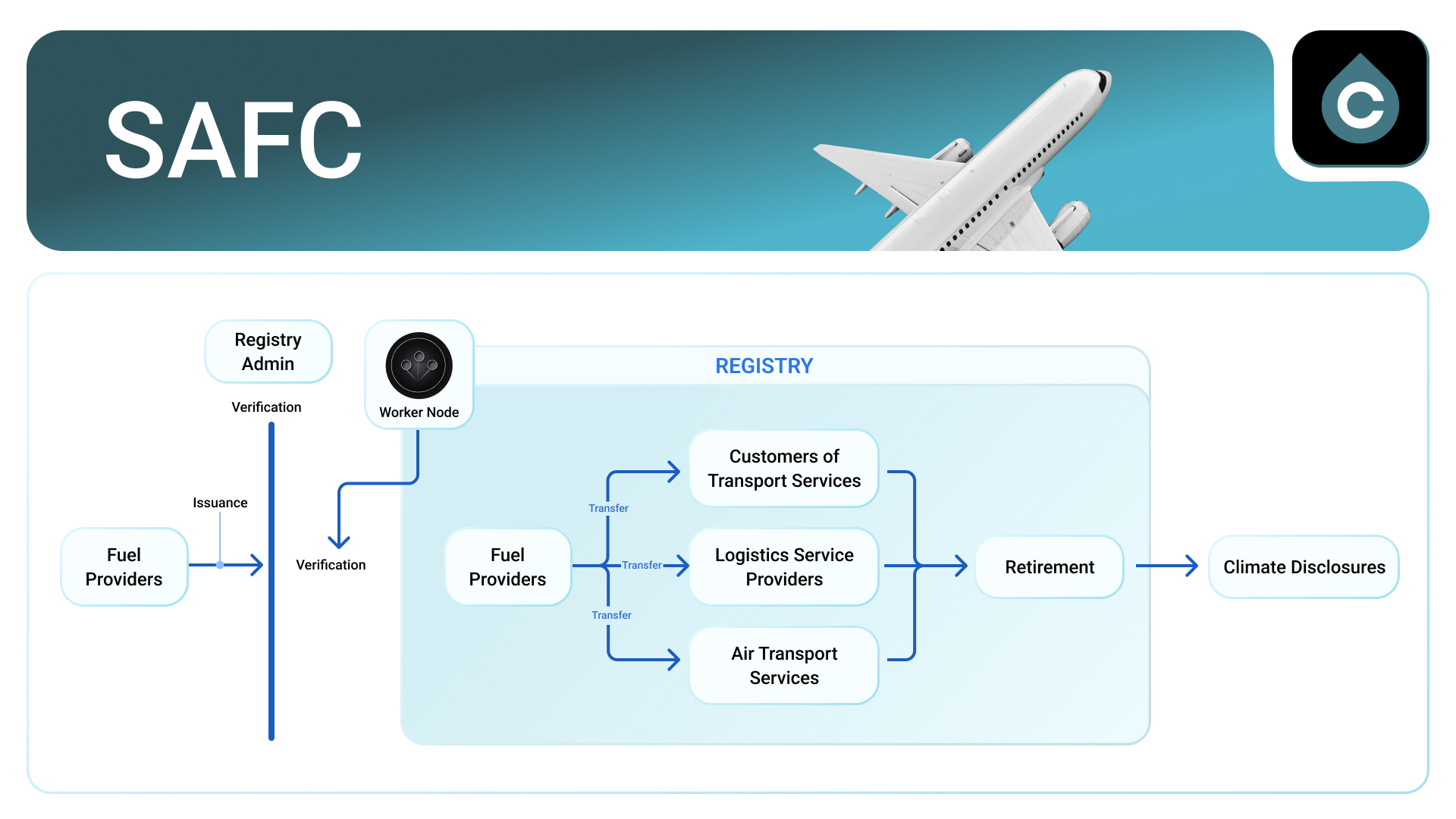
SAFc is an innovative system designed to accelerate the adoption of Sustainable Aviation Fuel (SAF) by using SAF certificates (SAFc) as verifiable proof that a specific volume of SAF has been produced in accordance with industry best practices. These certificates are issued and transferred throughout the value chain to aviation service customers, who ultimately retire them to support and demonstrate progress toward their sustainability goals. By enabling transparent tracking and credible claims, the SAFc solution brings greater accountability and trust to the aviation industry’s transition toward lower-carbon fuels.
A core feature of SAFc is its decentralized verification mechanism. Each SAF certificate is shared with a network of VCC Operators, who independently validate the certificate and related transactions against predefined rules and requirements. This includes verifying the accuracy of SAF production data and ensuring compliance with applicable regulatory and program standards.
To perform these validations securely, VCC Operators rely on cryptographic proofs and pseudonymized data. Through a consensus-based process, the operators collectively determine whether a SAF certificate is valid before it can be issued or transferred within the system. This decentralized approach helps prevent fraud, strengthens data integrity, and maintains trust across the SAFc ecosystem.
### SAFc Registry Background
The [SAFc Registry](https://safcregistry.org/) was launched in Q4 2023 as a collaboration between [Energy Web](https://energyweb.org/), [SABA](https://flysaba.org/), [RMI](https://rmi.org/), and [EDF](https://www.edf.org/) to decarbonize the aviation industry. Since then, it has grown into the largest SAF registry with over 220,000 tonnes of SAFc issued, 720,000 tonnes of CO2 abated, and over 100 corporate customers - from the world's largest multinationals to emerging climate-focused companies - using it to reduce their emissions. Certificate retirements continue to grow quarter over quarter, with an increasing number of airlines, fuel producers, and logistics partners active across the SAF value chain.
SAF is jet fuel produced from renewable feedstocks that emits significantly less carbon than petroleum-based jet fuel. For SAF producers, it is important to track the origin and attributes of the SAF to create new revenues by selling these attributes to environmentally conscious airlines and corporations. For airlines and consumers of air transport services, having a verifiable audit trail of SAF origin and attributes helps them implement credible decarbonization strategies.
The [SAFc Registry](https://safcregistry.org/) follows the "[book-and-claim](https://rmi.org/clean-energy-101-book-and-claim/)" chain of custody model: once the SAF is "booked" in the registry, its environmental attributes may move separately from the physical fuel. The registry tracks key information about the underlying SAF production, including who produced the fuel, what sustainability certifications they hold, the fuel's feedstock (e.g., waste cooking oil), how much SAF was produced (measured in tonnes), its estimated carbon savings per unit of fuel, when the SAF was blended with conventional aviation fuel, and other key information.
The [SAFc Registry](https://safcregistry.org/) offers the following to its users:
* Organizations and individuals can easily join the platform and create accounts with specific abilities based on the type of company they represent
* "Fuel Providers" are special organizations - that produce SAF and hold 3rd party certifications - that can provide generation / production data to the platform to issue SAFc
* All data fields represented on the platform stem from 3rd-party verified information and certifications, and SAFc may only be issued by accounts holding the proper credentials
* The Registry's web-interface is very user-friendly and familiar to corporate users; power users may interact with the platform via API
* VCC Operators on Energy Web X provide transparency into the inner-workings of certificate issuances, transfers, and retirements, allowing registry users, stakeholders, and the public to trust that the registry is operating with integrity
#### SAFc on Verified Compute Cloud
As of December 2025, the SAFc Registry runs on Energy Web's Verified Compute Cloud (VCC Protocol), enabling continuous, real-time verification of certificate operations rather than relying on periodic audits. The [Verified Data Explorer](https://verify.safcregistry.org/) allows anyone to publicly validate whether critical steps in the certificate process have been executed correctly, including:
* CO2e impact calculation: how many tonnes of CO2e are abated by a given certificate, and what emissions reduction the underlying SAF represents relative to conventional jet fuel
* Double-counting prevention: whether a certificate has been previously claimed in the registry
* Rulebook compliance: whether a retirement has a valid beneficiary type, claim year, disclosed production and blending dates, and retirement date
All verification results are anchored immutably on Energy Web X, creating a permanent, publicly auditable record for every certificate event.
---
# Agent Instructions
This documentation is published with GitBook. GitBook is the documentation platform designed so that both humans and AI agents can read, navigate, and reason over technical content effectively. Learn more at gitbook.com.
## Querying This Documentation
If you need additional information that is not directly available in this page, you can query the documentation dynamically by asking a question.
Perform an HTTP GET request on the current page URL with the `ask` query parameter, and the optional `goal` query parameter:
```
GET https://docs.energyweb.org/energy-solutions/green-proofs-by-energy-web/use-cases-and-reference-implementations/sustainable-aviation-fuel.md?ask=&goal=
```
`ask` is the immediate question: it should be specific, self-contained, and written in natural language.
`goal` is optional and describes the broader end goal you are ultimately trying to accomplish on behalf of the user. GitBook uses it to tailor the answer towards what is most useful for that goal.
The response will contain a direct answer to the question and relevant excerpts and sources from the documentation.
Use this mechanism when the answer is not explicitly present in the current page, you need clarification or additional context, or you want to retrieve related documentation sections.