> For the complete documentation index, see [llms.txt](https://docs.energyweb.org/llms.txt). Markdown versions of documentation pages are available by appending `.md` to page URLs; this page is available as [Markdown](https://docs.energyweb.org/energy-solutions/green-proofs-by-energy-web/use-cases-and-reference-implementations/green-proofs-for-electrical-vehicles.md).
# Green Proofs for Electrical Vehicles
The Green Proofs for EVs (GP4EV) system plays a crucial role in ensuring that electric vehicle (EV) charging is green by managing and verifying green certificates for each charging session. All the data sent to workers in this process originates from the Green Proofs application, which transforms this data into operations like issuing, transferring, or retiring certificates.
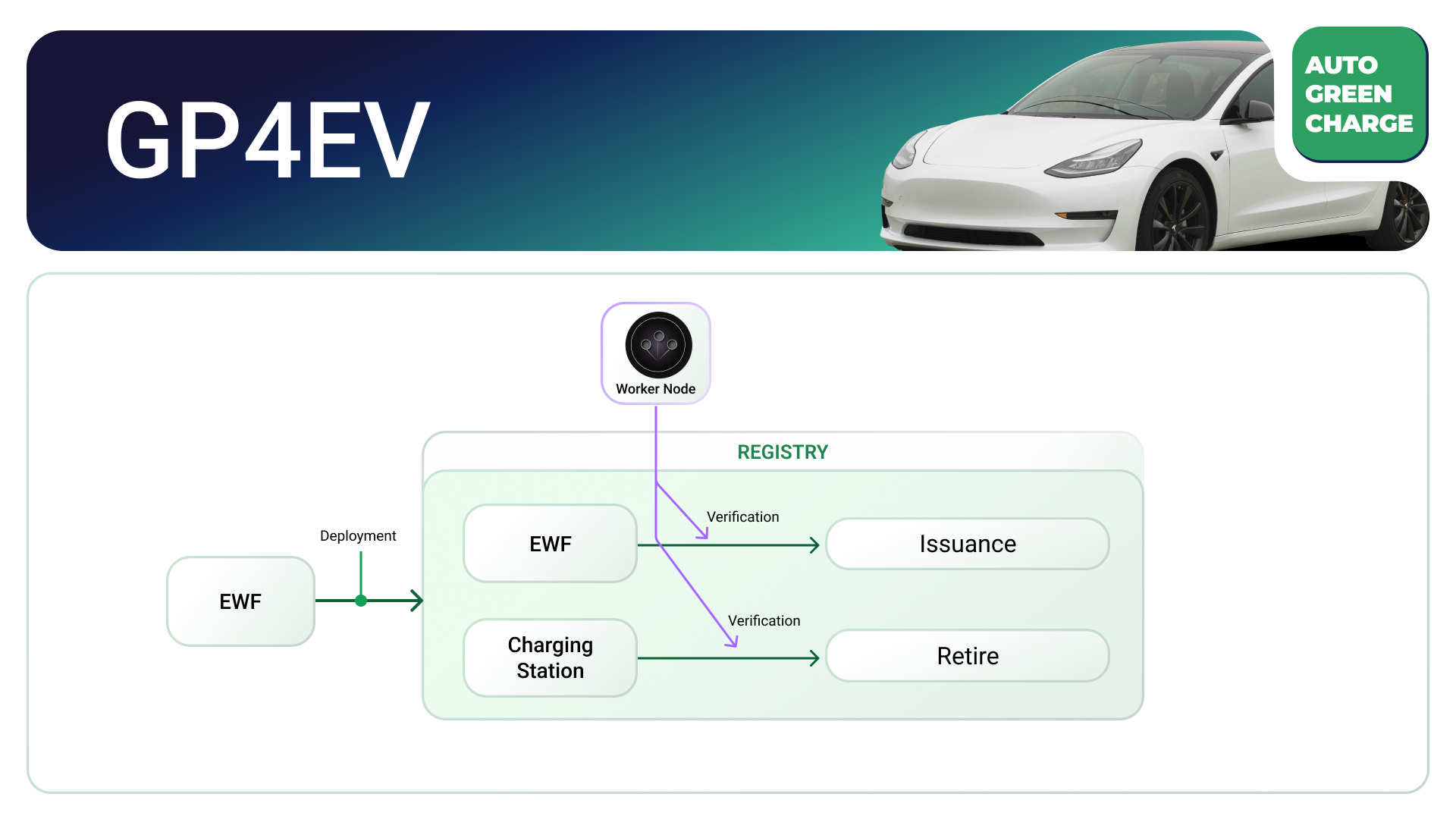
GP4EV overview
When the system receives a charging session request, GP4EV converts it into an appropriate operation, such as retiring a specific number of green certificates (e.g., retiring 10 units to reflect a green charge). This operation is then sent to workers through a distribution proxy. Each worker, instead of verifying the charging session directly, checks whether the certificate-related operation, like the retirement of green certificates, is valid based on the previous information they received.
For example, if a certificate with a volume of 100 units is issued, workers are informed of this, but only through a pseudonymized ID. When a charging session leads to the need to retire 10 units, the workers vote on whether this retirement is possible, ensuring the operation aligns with the current state of the system. This decentralization of knowledge allows for consistent state verification without any worker having access to the full scope of data, promoting security and efficiency in managing green EV charging.
---
# Agent Instructions
This documentation is published with GitBook. GitBook is the documentation platform designed so that both humans and AI agents can read, navigate, and reason over technical content effectively. Learn more at gitbook.com.
## Querying This Documentation
If you need additional information that is not directly available in this page, you can query the documentation dynamically by asking a question.
Perform an HTTP GET request on the current page URL with the `ask` query parameter, and the optional `goal` query parameter:
```
GET https://docs.energyweb.org/energy-solutions/green-proofs-by-energy-web/use-cases-and-reference-implementations/green-proofs-for-electrical-vehicles.md?ask=&goal=
```
`ask` is the immediate question: it should be specific, self-contained, and written in natural language.
`goal` is optional and describes the broader end goal you are ultimately trying to accomplish on behalf of the user. GitBook uses it to tailor the answer towards what is most useful for that goal.
The response will contain a direct answer to the question and relevant excerpts and sources from the documentation.
Use this mechanism when the answer is not explicitly present in the current page, you need clarification or additional context, or you want to retrieve related documentation sections.